Yellowstone National Park Background: The Essential Design Asset
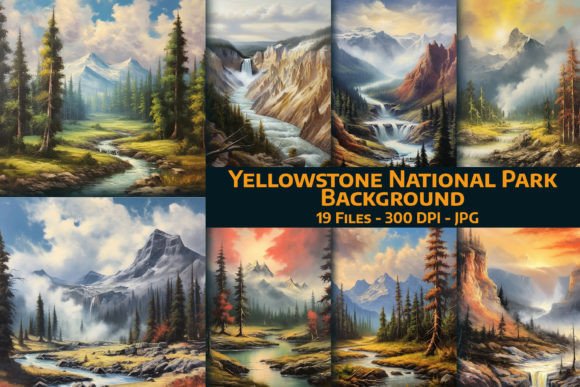
If you’ve ever stood at the edge of the Grand Prismatic Spring or watched Old Faithful erupt against a twilight sky, you know the visual weight of Yellowstone. It is a landscape of contrasts—steaming geothermal vents against cool pine forests, rugged mountains meeting delicate wildflowers. Capturing that specific aesthetic for a design project usually requires a photographer, specific lighting, and a lot of luck. However, for designers, marketers, and content creators looking to inject that majestic, organic atmosphere into their work, the Yellowstone National Park Background bundle offers a practical, high-quality solution.
This collection isn't just a random assortment of photos; it is a curated set of design assets intended for professional use. The bundle contains 19 distinct JPEG designs, each rendered at a high resolution of 300 DPI and sized at 3600×3600 pixels (12×12 inches). These specifications are crucial for anyone working in print or digital media. Whether you are a scrapbooker preserving memories or a brand strategist developing a new visual identity, these files provide the fidelity required to maintain professionalism.
Capturing the Aesthetic: Visual Characteristics and Appeal
The visual language of Yellowstone is complex. It ranges from the stark, alien beauty of the Mammoth Hot Springs terraces to the deep, rich blues of the Yellowstone River. This bundle translates those elements into versatile textures and scenes. When we talk about the "personality" of these backgrounds, we are discussing an earthy, grounded, and timeless quality.
Unlike generic stock photos that can feel sterile, these backgrounds carry a sense of history and nature. The textures are organic, making them an excellent counterpoint to modern typography. For example, the rough, gritty texture of volcanic rock pairs beautifully with a clean sans serif font, while the soft, flowing gradients of a sunset over the Lamar Valley can complement a delicate script font. The overall appeal lies in their versatility; they can act as a dominant visual element or a subtle backdrop that adds depth without overwhelming the foreground content.
Practical Applications for Creators and Businesses
The utility of a high-quality background extends far beyond simple decoration. For graphic designers and marketers, these images serve as foundational layers for social media graphics and web design. A nature-based background can instantly soften the hard edges of corporate branding, making a company appear more approachable and eco-conscious.
Here are a few practical ways to integrate these assets into your workflow:
- Editorial Design: Use the backgrounds as full-bleed images for magazine covers or blog headers. The 12x12 inch size makes them perfect for square-format layouts common on Instagram and Pinterest.
- Packaging Design: If you are designing for a product that wants to evoke "natural," "handcrafted," or "adventure" themes—like a craft coffee brand or outdoor gear—these textures provide an authentic base layer.
- Scrapbooking and Personal Projects: The 300 DPI resolution ensures that printed albums look crisp. The nature themes are perfect for documenting travel, family outings, or seasonal projects.
- Presentations: Move away from boring corporate templates. Using a subtle Yellowstone background for a keynote slide can keep the audience engaged without distracting from the data.
Influencing Brand Perception and Readability
Choosing the right background is a strategic decision. In brand identity design, every visual element contributes to how a customer perceives the business. A Yellowstone National Park Background suggests stability, endurance, and natural beauty. If your brand values align with sustainability, ruggedness, or tranquility, these assets can reinforce that message subconsciously.
However, designers must be mindful of visual hierarchy. A busy background can easily crush readability if not handled correctly. When overlaying text on these detailed nature scenes, contrast is your best friend.
Consider these design observations:
- The Overlay Technique: If the background image is vibrant or complex, place a semi-transparent color overlay (like a dark charcoal or a brand color at 50% opacity) between the image and the text. This allows the texture to show through while ensuring the typography pops.
- Typography Selection: Avoid using a handwritten font or overly ornate serif font directly over a textured rock formation or dense forest pattern. The visual noise will make the text illegible. Instead, opt for a bold, modern typography style with ample letter spacing.
- Negative Space: Look for areas within the JPEGs that have natural negative space—perhaps a patch of sky or a smooth body of water—and place your headlines there.
Evaluating Fit and Technical Implementation
Before committing to using the Yellowstone National Park Background bundle in a commercial campaign, it is wise to evaluate the technical fit. Because these files are JPEG designs, they are raster-based. This means they are resolution-dependent. While 3600x3600 pixels is generous and suitable for most print applications (like A3 posters or square flyers), you should avoid extreme cropping if you intend to print large-scale banners.
For digital design, the files are ready to use immediately. They can be imported directly into Photoshop, Illustrator, Canva, or Procreate. When working on logo design, treat these backgrounds as environmental elements rather than parts of the logo mark itself. A logo needs to be scalable vector art, but it can be presented against a Yellowstone background to show how it looks in a real-world context, such as on a website hero image or a business card mockup.
Conclusion: A Versatile Tool for Visual Storytelling
Ultimately, the value of a design asset lies in its ability to solve problems. The Yellowstone National Park Background bundle solves the problem of sourcing high-quality, thematic nature imagery that is consistent in style and resolution. It provides a cohesive visual thread that can tie together a website, a social media campaign, and printed materials.
For the creative professional, this is more than just a collection of pictures. It is a toolkit for evoking emotion. By combining these backgrounds with thoughtful typography and strategic layout design, you can create work that feels grounded, authentic, and visually compelling. Whether you are building a brand from scratch or refreshing a blog, these assets offer a reliable foundation for your creative vision.